



Laurence is a copywriter and trained journalist. His passion is creating insightful and educational content for dental professionals of every level. Outside of work, he enjoys watching sport, quizzing and spending time with his family.
Shopping for dental instruments requires knowing exactly what each instrument does and what qualities to look out for. Our guide aims to help you understand the most common types of dental hand instruments and their functions, so that you can make an informed decision when it comes to buying.
Dental instruments are small pieces of hand-held equipment used to examine, treat, restore and remove teeth. They are typically made of either stainless steel or disposable plastic, and will often fall under one of two categories: non-cutting and cutting. Though many of these instruments look similar, most are designed for a specific area of dentistry, such as examinations, restorations or periodontics. Instruments can be purchased individually or in kits made up of an assortment of instruments. Here is our guide to the most frequently used dental instruments.
Dental Mirrors
The dental mirror is made up of a handle, stem and rounded head. These components can be purchased individually as replacement parts.
Its most common uses are exploring areas of the mouth where visibility is difficult or impossible, and retracting the tongue or cheeks for better access and vision. It can also be used to reflect light onto desired surfaces.
Mouth mirrors can be single sided or double-sided. Double-sided mirrors are designed for greater illumination and visibility.
The most common sizes of mirror are no.2 (18mm), no.4 (22mm) and no.5 (24mm). Features to look out for include anti-grip for improved handling, scratch resistance for less distortion and minimal crevices for easier cleaning.

Non-Cutting Instruments
Dental Mirrors
The dental mirror is made up of a handle, stem and rounded head. These components can be purchased individually as replacement parts.
Its most common uses are exploring areas of the mouth where visibility is difficult or impossible, and retracting the tongue or cheeks for better access and vision. It can also be used to reflect light onto desired surfaces.
Mouth mirrors can be single sided or double-sided. Double-sided mirrors are designed for greater illumination and visibility.
The most common sizes of mirror are no.2 (18mm), no.4 (22mm) and no.5 (24mm). Features to look out for include anti-grip for improved handling, scratch resistance for less distortion and minimal crevices for easier cleaning.
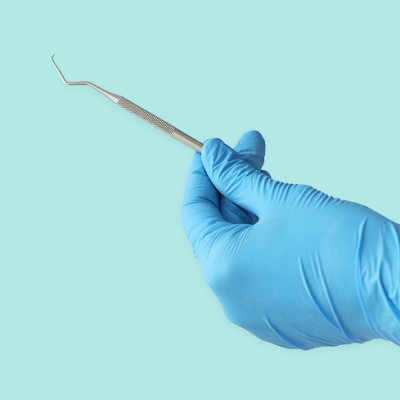
Dental probes, sometimes referred to as explorers, are sharp, thin and flexible instruments used to examine teeth for decay, calculus and other oral issues. They can also be used to detect the integrity of fillings with the surrounding teeth and check margins of crowns.
The three main types of explorers are distinguishable by their working ends. Most common is the Shepherds Hook (No. 23) which has a curved end. The No. 17 Explorer has a flatter and shorter hook and is used for interproximal areas between the teeth. The third type is the Pigtail Explorer, which is used to curve under and around the teeth.
Dental probes
Dental probes, sometimes referred to as explorers, are sharp, thin and flexible instruments used to examine teeth for decay, calculus and other oral issues. They can also be used to detect the integrity of fillings with the surrounding teeth and check margins of crowns.
The three main types of explorers are distinguishable by their working ends. Most common is the Shepherds Hook (No. 23) which has a curved end. The No. 17 Explorer has a flatter and shorter hook and is used for interproximal areas between the teeth. The third type is the Pigtail Explorer, which is used to curve under and around the teeth.
Briault probes are very similar to periodontal probes but differ in that the working end is sharp. A briault probe can be used to detect caries in between surfaces of the teeth which the dental mirror cannot find. It can also be used to detect hidden tartar build up in the gums.
Amalgam Pluggers (Condensers)
Amalgam pluggers, or condensers as they are also known, are used to pack and condense filling material into the base of a cavity preparation. The instrument is used to ensure the material fills all corners and edges of the tooth, areas that can sometimes be missed if using a glove to squish the material. Amalgam condensers can have either one or two flat working ends. Look out for pluggers that have a hollow handles to reduce the overall weight and handling of the instrument.
Amalgam Carriers
Amalgam carriers are used to carry and dispense amalgam filling material to a tooth cavity. The working end of the carrier is hollow and the non-working end is a plunger which is used to push the amalgam out. Amalgam carriers have various sizes of tips for the different amounts of amalgam needed. The working end can be straight or curved. Most metal and plastic amalgam carriers are autoclavable for multi-use.
A simple definition of CAD/CAM dentistry is the use of digital software to design and manufacture dental restorations and prostheses. CAD stands for computer-aided design and CAM stands for computer-aided manufacturing. The technology can be used to create crowns, dentures, inlays, onlays, bridges and veneers among other things. The speed of the CAD/CAM process allows for dental prosthetics to be designed, manufactured and delivered to the patient in quick time, sometimes the same day. The wider system of using computer assisted technologies to produce restorations is known as CEREC (Chairside Economical Restoration of Aesthetic Ceramics).
Cutting Instruments
Dental Scalers
Scalers are used to remove calculus from the tooth, including in the tiny pockets. They are usually two-sided with two working ends. Dental scalers can be either universal and designed for use anywhere in the mouth, or they can be designed specifically for certain teeth and areas.
Sickle scalers have a sharp point and are recommended for removing calculus above the gum line. Curettes are recommended for removing calculus below the gum line (subgingival calculus) and have rounded ends to ensure less damage to the gingiva.
The best dental scalers will be ergonomic and lightweight. Cybertech scalers and most other dental instruments from Cybertech come with hollow handles for improved handling.

Dental Burs
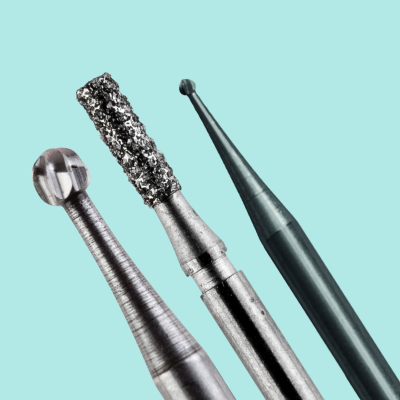
Dental burs attach to a handpiece and are used for cutting and polishing hard tissues of the mouth. There are several types of dental burs used for different types of procedures. The three most common type of dental bur are
- Diamond burs.
- Tungsten carbide burs.
- Steel burs.
)
Need support? Get In Touch Today.
Dental Elevators
Elevators are single ended instruments used to loosen and elevate the teeth in their sockets prior to extraction. This is done to create space and prevent trauma to adjacent teeth and tissues.
The most common type of elevator is the Couplands Elevator, sometimes referred to as a chisel. Coupland elevators are often used in a set of three, each of increasing size. These are used in order to split multi-rooted teeth. They’re inserted between the bone and tooth roots and rotated to elevate and extract the tooth out of the socket.