


 Back
Back


- Back
- Infection Control
Shop Our Top Infection Control Products







- Back
- Pharmaceuticals










- Back
- Offers and Promotions



Laurence is a copywriter and trained journalist. His passion is creating insightful and educational content for dental professionals of every level. Outside of work, he enjoys watching sport, quizzing and spending time with his family.
What Is Dental Cement?
Dental cement is used to connect a fixed prosthesis, such as a crown or bridge, to the underlying tooth structure. It can also be used as a pulp-protecting agent, cavity-lining material or temporary filling. Most dental cements come as a powder which is mixed with water to form a viscous liquid. Modern cements, such as glass ionomer cement, also come in capsule form which is mixed in a special machine. Dental cements can be classified as either permanent or temporary. Permanent cement is used to permanently attach a prosthesis. Temporary dental cement is used between appointments mainly for evaluation purposes.
Zinc oxide eugenol (ZOE) cement
Zinc oxide eugenol cement (ZOE) is an oil-based cement used primarily as a temporary dental cement. ZOE has an anti-inflammatory effect on the pulp and is especially useful for cementation on prepared teeth with exposed dentinal tubules.
Composition
Zinc oxide eugenol cement comes in two forms, either a powder (zinc oxide) and liquid (eugenol, olive oil, zinc acetate), or as a two-paste system with a similar formulation to the powder and liquid.
Indications
- Temporary cementation of crowns and bridges
- Cavity base and lining material
- Provisional restoration of teeth
Advantages
- Soothes pulp
- Good sealing ability
- Neutral PH
- Least technique sensitive dental cement
Disadvantages
- Brittle (weakest cement)
- Eugenol inhibits polymerisation of resin so should be avoided if final restoration is resin-based
- Most soluble cement in mouth fluids
- Low strength
Zinc phosphate cement
Zinc phosphate cement has the longest history of all the dental cements and still the preferred choice for many dentists. The cement does not have a chemical bond to the underlying tooth structure so is used mainly as a luting agent for many types of indirect restorations.
Composition
Zinc phosphate comes as a powder (zinc oxide), which acts as the base, and a liquid (aqueous solution of phosphoric acid). The two are mixed by hand to form the cement. This is normally done on a chilled glass slab due to the mixture’s exothermic reaction which gives off a lot of heat.
Indications- Cementation of crowns, bridges, inlays and onlays
- Temporary restorations
- Cavity liner
Advantages
- Long clinical history
- Low cost
- Excess material is easily removed
- Low film thickness
- High compressive strength
Disadvantages
- High acidity can cause pulpal irritation
- Exothermic (technique sensitive)
- Weak aesthetics
- Soluble in mouth fluids
- No chemical adhesion
Zinc polycarboxylate cement
Zinc polycarboxylate was the first dental cement with the ability to chemically bond to the tooth surface when it was created in the late 1960s. It is used primarily for the permanent cementation of crowns, bridges and other dental prosthesis.
Composition
Zinc polycarboxylate comes as a powder (zinc oxide), which acts as the base, and a liquid (aqueous solution of polyacrylic acid). The two are mixed by hand to form the cement.
Indications
- Cementation of crowns, bridges, inlays and onlays
- Cavity base to protect the dental pulp
- Temporary restorations
- Cementation of orthodontic bands and other orthodontic appliances
Advantages
- Minimal pupal irritation
- Chemical adhesion to tooth
Easy to manipulate - Antibacterial
- Low film thickness (similar to zinc phosphate)
- Some can release fluoride
Disadvantages
- Short mixing/working times
- Lower compressive strength than zinc phosphate cement
- Soluble in mouth fluids

Need support? Get In Touch Today.
Glass ionomer cement
Glass ionomer cement (GIC) is one of the most popular dement cements. Its rise in popularity is owed in large part to its aesthetics and ability to store and release fluoride, which can help reduce the chances of cavities and tooth decay. GIC chemically bonds to dentine and enamel without the need for additives.
Composition
GIC can have a range of compositions, but the chief ingredients of conventional glass ionomer are basic glass (sodium aluminosilicate) and an acidic water-soluble powder that sets by an acid–base reaction between the two components. Glass ionomer cement comes in either liquid and powder bottles or in a capsule form where the right proportion of powder and liquid has already been set.
Indications
- Permanent cementation of crowns, bridges, inlays and onlays
- Cavity liner
- Restoration of deciduous teeth
- Restoring erosion lesions
Advantages
- Chemical adhesion to tooth
- Strong fluoride release over time
- Good match to natural tooth colour
- Easy to mix
- Radiopaque
Disadvantages
- Soluble in mouth fluids
- Technique-sensitive mixing
- Brittle and not recommended for high stress bearing areas
Resin modified glass ionomer cement
Combining the advantages of GIC and resin composites, resin modified glass ionomer cement (RMGIC) is the most used dental cement. The addition of the resin component to the glass ionomer gives it a higher strength and lower solubility than glass ionomer.
Composition
RMGICs are conventional GICs containing glass, polyacid, tartaric acid and water, with the addition of a water-soluble resin and modified polyacrylic acids. It has two setting reactions: an acid-base setting and a free-radical polymerisation, which is the preferred choice as it is quicker and ensures optimal curing.
Indications
- Permanent cementation of crowns, bridges, inlays and onlays
- Cavity liner
- Cementation of orthodontic bands and other orthodontic appliances
- Restore carious and non-carious lesions
Advantages
- Stronger and less soluble compared to conventional glass ionomer cement
- Fluoride release
- Part chemical adhesion to tooth
- Dual cure
- Considered best cement for zirconia (ceramic but no glass) and metal crowns (porcelain fused to metal crowns and full gold)
Disadvantages
- Setting expansion can lead to cracking of all-ceramic crowns
- Technique sensitive (short setting time so requires quick placement and shaping)
Resin cement
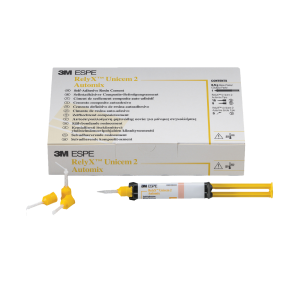
Resin cement offers the best compressive strength of all dental cements. It comes in light cure (requires a curing light to set), chemical cure and dual cure (can be light cured but can also chemically cure). Some resin cements are self-adhesive, meaning they can be applied directly to the tooth. Other resin cements have no chemical bond and require additives.
Composition
Resin cements are largely composed of a resin matrix and filler or fine inorganic particles (20-80%). It is available as a two-paste system, powder and liquid or in capsules.
Indications
- Permanent cementation of crowns, bridges, inlays and onlays
- Indirect resin restorations
- Veneers
- Fibre posts
- Orthodontic brackets
What Are The Ideal Characteristics Of A Dental Cement?
The ideal properties of a dental cement include:
- Non-irritating to the dental pulp
- High tensile and compressive strength
- Adheres to tooth structure
- Minimal film thickness (ideally 25 microns)
- Seals margins
- Radiopaque for diagnostic purposes on x-rays
- Good natural tooth like aesthetics
- Low solubility in mouth fluids
- Easy to use
- Optimal working and setting time
- Not too expensive
What Is The Best Dental Cement?
No dental cement is perfect. Each has its own unique advantages and disadvantages. GIC, RMGIC and resin cements are better quality, stronger and less soluble compared to the zinc-based cements and are generally used for most permanent cementation procedures in modern dentistry.
Cements & Liners

Share


